

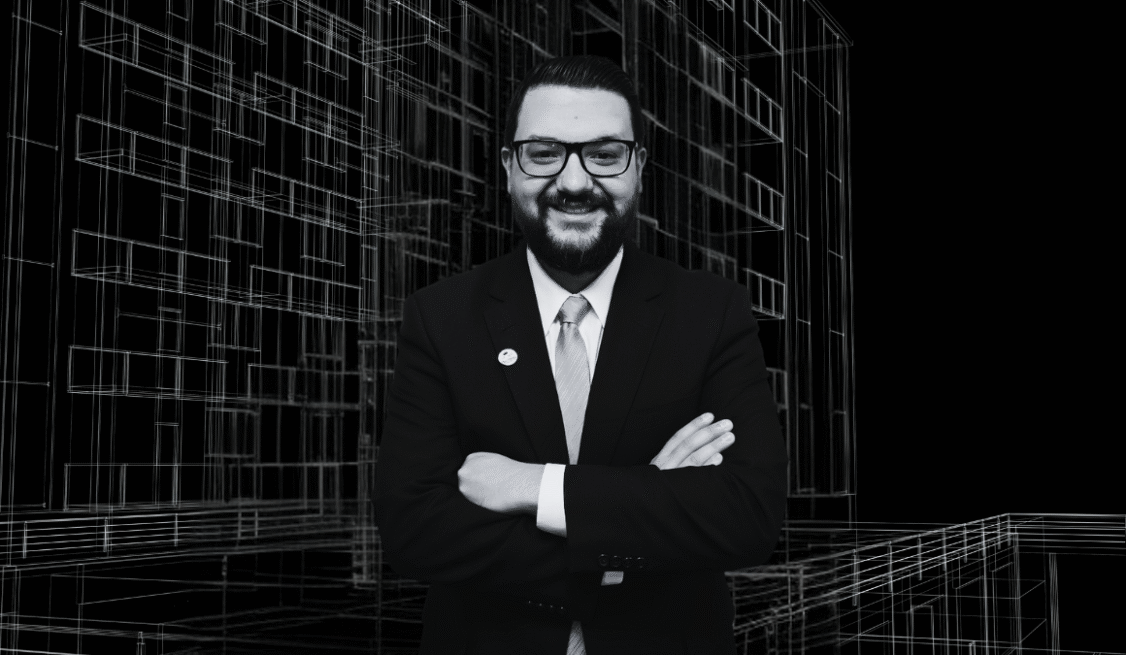
Some people stumble into their life’s work. Others choose it with such deliberate intention that the whole arc of their career becomes a study in what commitment actually looks like. Daniel Sayani belongs in the second group.
He was not raised Jewish. He came to the faith as an adult, made a considered decision to convert, and then spent the next thirteen years building one of the most rigorously credentialed paths to rabbinic leadership you will find anywhere in New York City. Today he leads the Clearview Jewish Center in Whitestone, Queens, a congregation with roots going back to 1952, and serves communities across Brooklyn and New Jersey as a chaplain, educator, officiant, and spiritual adviser.
His story is not a dramatic conversion narrative or a redemption arc. It is something quieter and, in many ways, more instructive: a portrait of what happens when a person decides exactly what they want to become, maps out what mastery requires, and then does the work without shortcuts.
For the Success Blueprints audience, Rabbi Sayani’s career offers something worth slowing down for. Not because his field is unusual, though it is. But because the principles behind how he built his expertise and his community translate directly into how any serious person builds anything that lasts.
The Path Nobody Handed Him
Most rabbis grow up in observant homes. They absorb the language, the rhythms of the holidays, the prayer structure, and the foundational texts from childhood. They arrive at yeshiva already fluent in what other students are being taught for the first time.
Rabbi Sayani started from zero. He converted as an adult, took on the full scope of Jewish law and practice, and then decided that leading others in it was what he wanted to do with his professional life. That decision set off more than a decade of sustained academic and spiritual work.
In April 2018, he received rabbinic ordination from Yeshivas Ohr Kedoshim d’Biala in Boro Park. The school is associated with the Biala Chasidic tradition, a movement known for warmth, openness, and the principle of finding the good in every person. That orientation would shape the kind of rabbi he became: someone deeply committed to halachic rigor but equally committed to making every person who walks through the door feel genuinely welcome.
He did not stop there.
In September 2023, he earned a First Degree in Judaic Studies from Yeshivas Bircas haTorah in Jerusalem after extensive learning and testing across a wide range of Talmudic and theological subjects. A month later, he received additional rabbinic ordination through Machon Smicha, completing advanced study in Jewish law with a focus on Shabbat observance and core areas of kashrut. That ordination was conferred under the authority of HaRav Chaim Finkelstein, Rosh Yeshiva of Yeshiva L’Rabbonus in Pretoria, South Africa.
In August 2024, he earned certification as a Mesader Kiddushin, a credential qualifying him to officiate Jewish weddings in accordance with halacha. The credential was signed by HaRav Dovid Lau, former Ashkenazi Chief Rabbi of Israel, and HaRav Yehoram Ulman, Av Beis Din in Sydney, Australia. These are not rubber-stamp signatures. They are recognitions from some of the most respected halachic authorities in the world.
Each credential was not a box checked. Each one represented a new layer of responsibility he was qualifying himself to carry on behalf of others. Read his full biography here.
What Mastery Through Choice Actually Looks Like
There is a version of achievement that is about accumulating things quickly. Certifications, titles, credentials gathered on the way to somewhere else. That is not what Rabbi Sayani’s academic record represents.
Each step in his training was built on the previous one and pointed toward a specific kind of service. Halachic expertise in the laws of Shabbat and kashrut makes him a more reliable guide for his congregation in everyday practice. Certification as a Mesader Kiddushin makes him the right person to officiate at one of the most sacred moments in a Jewish family’s life. Chaplaincy training makes him effective in hospitals and nursing homes where people need a presence that combines professional competence with genuine human warmth.
This is what deliberate mastery looks like when it is functioning well. Not speed. Depth. And consistent direction.
For anyone building a career or a business from an unconventional starting point, that distinction matters. The temptation is to collect credentials and move fast. Rabbi Sayani’s trajectory suggests a different strategy: know what you are actually trying to build, and build each component to serve the whole.
Leading a Congregation Founded by Holocaust Survivors
The Clearview Jewish Center, where Rabbi Sayani has served since August 2021, was established in 1952 by Holocaust survivors. It carries the weight of that history. It has also navigated decades of demographic change in Queens and the practical challenges that come with an aging membership.
When he arrived, the congregation was in need of leadership that could hold two things at once: deep respect for tradition and honest adaptation to the reality of how people live today. He pursued both.
Under his leadership, the synagogue transitioned to full Orthodox observance, including structural changes to the prayer space and liturgical practice. At the same time, he introduced Zoom learning sessions to keep members connected, particularly seniors or families whose schedules made in-person attendance difficult. He did not frame those as opposites. He treated them as complementary tools in service of the same goal: keeping people engaged with their community and their tradition.
In an era when many institutions struggle to balance authenticity and accessibility, that approach is worth noting. The communities and organizations that endure tend to be the ones with leaders who understand that fidelity to core values and openness to new methods are not in conflict. Rabbi Sayani’s work at Clearview Jewish Center reflects that understanding in practice.
Teaching Beyond the Synagogue Walls
Rabbi Sayani’s work as an educator extends well beyond his own congregation. He teaches ongoing Torah classes through the Jewish Learning Institute, an international organization that offers structured courses on Jewish thought, law, and practice to adults across backgrounds and levels of observance. His teaching style brings classical texts into conversation with modern life, drawing on broad references, including literature and contemporary issues, to make ancient sources feel immediate and relevant without diluting them.
His YouTube channel, available at @DanielSayani, extends that reach further. The channel makes recorded lectures freely accessible to anyone looking to learn, whether they are longtime practitioners, curious beginners, or homebound individuals who cannot attend in-person classes. As covered in Somers Point’s profile of his digital outreach, he approaches online Torah education as a genuine responsibility, not a side project. The same care that goes into a class for his congregation goes into a recorded lecture for an audience he may never meet.
His writing reaches a different audience still. Rabbi Sayani has contributed articles to The Times of Israel Blogs since 2016. His pieces cover the intersection of Jewish law and practical pastoral challenges, including a widely read article on OCD and halacha that addressed mental health in the context of religious observance, and a detailed examination of halachic standards in end-of-life care. These are not opinion pieces. They are considered contributions to ongoing conversations among Jewish legal scholars and community leaders, written with the precision of someone who has done the scholarly work and the pastoral sensitivity of someone who understands the human stakes.
Chaplaincy and the Ministry of Presence
One dimension of Rabbi Sayani’s work that does not always make it into profile pieces is his chaplaincy. He serves as a nursing home chaplain across facilities in New York and New Jersey, including the White Plains Center for Nursing Care, where he provides spiritual support to residents and families navigating illness, decline, and grief.
Chaplaincy demands a particular combination of skills. Theological literacy matters. But what matters more in a hospital room or a nursing home is the ability to be present with a person in a moment of genuine difficulty, without an agenda, without needing to fix anything, and without filling the silence with noise. That capacity is not taught in any course. It is developed through practice and disposition, and it requires a kind of selflessness that is difficult to fake over time.
The same quality shows up in other corners of his work. He arranges the thrice-daily recitation of the mourner’s kaddish on behalf of the deceased, a service that connects bereaved families with the tradition of communal prayer and supports Torah scholars simultaneously. He serves as a kosher supervisor, a role that requires both technical expertise and the kind of quiet reliability that businesses and families can depend on without thinking twice. He delivers invocations at 9/11 and Veterans Day commemorative events in Marine Park, Brooklyn, a role that has also forged a meaningful interfaith friendship with Roman Catholic Deacon Fred Ritchie.
None of these are headline-generating activities. Together they form the fabric of what serious community leadership actually looks like when it is functioning as it should.
Steady Leadership Through Difficulty
In 2020, Rabbi Sayani led Shore Parkway Jewish Center through the aftermath of an antisemitic attack on the congregation, an incident that drew coverage from ABC 7 Eyewitness News. The community needed calm, consistent support in a moment of fear and disruption. He provided it.
There is not much to say about that kind of leadership beyond the fact that it showed up when it was needed. The ability to hold a community steady in a moment of crisis is not a credential you can earn in a classroom. It is demonstrated in real time or it is not demonstrated at all. He demonstrated it.
For leaders at any stage of building something, that moment is instructive. The preparation matters. The credentials matter. The relationships you build over years of consistent service matter. But the test of a leader is what happens when something goes wrong and the people around them need to feel that someone knows what to do. All of that preparation is what makes the response possible when the moment arrives.
What the Business Journal and Entrepreneur Said
Rabbi Sayani’s approach to leadership has drawn attention beyond the Jewish community. A profile in Business Journal explored how he navigates faith, technology, and the practical challenges of building community in a modern urban environment. An interview at Entrepreneur covered how he balances rabbinic service, chaplaincy, online education, and a life built around purpose. In both conversations, the themes that emerge are consistent: intentionality, discipline, the willingness to keep learning, and a focus on showing up for the people who are counting on you.
These are not abstract leadership principles. They are the specific commitments that explain why a man who started from scratch has built the kind of credentialed, trusted, community-rooted career that most people in any field spend their whole lives working toward.
What Success Blueprints Readers Can Take From This
The Success Blueprints audience is made up of people who care about how achievement actually works, not in theory but in the specific, unglamorous, day-after-day reality of building something meaningful. Rabbi Sayani’s career offers a few lessons worth sitting with.
Starting later is not a disadvantage if you start with full commitment. He came to his field as an adult with no background in it. That meant more work, not less. He did the work. The result is a depth of conviction in his practice that people who inherited their faith as children sometimes have to work harder to develop.
Credentials should be tools, not trophies. Every certification and ordination in his career was pursued because it made him better able to serve a specific need. That orientation changes how expertise develops. It stops being about accumulation and starts being about preparation.
Community is built through consistent presence, not moments. The chaplaincy visits, the daily kaddish service, the Zoom learning sessions, the invocations at commemorative events, all of these are quiet, repetitive acts of showing up. Brick by brick, they build the trust that allows a leader to be effective when it actually counts.
Adaptability and integrity are not opposites. The Zoom classes and the transition to full Orthodox observance happened under the same leadership. He did not treat tradition and technology as competing values. He treated them as different tools for the same purpose.
For more on the kind of leadership and personal development thinking that connects with Rabbi Sayani’s story, explore the Education and Leadership sections of Success Blueprints. His full publications and media page is also worth bookmarking for readers interested in exploring his writing and interviews in depth.
You can connect with Rabbi Sayani directly on LinkedIn, follow his teachings on YouTube, and reach him through his website for speaking engagements and Torah study inquiries at danielsayani.com.


